 Athmane Benarous
Research & papers
Each entry has an abstract or summary, my own part of the work, and the PDF or code where I can share it.
- Sep 2024 – present
A Platform for the Semi-automatic Segmentation, Characteristic Shape Analysis and Simulation of Neuronal Somas
What I did
Built the soma segmentation module (segmentation modes, thresholding, median filtering, marker constraints) and, since the capstone, a Dice-based evaluation against hand-labelled gold standards.
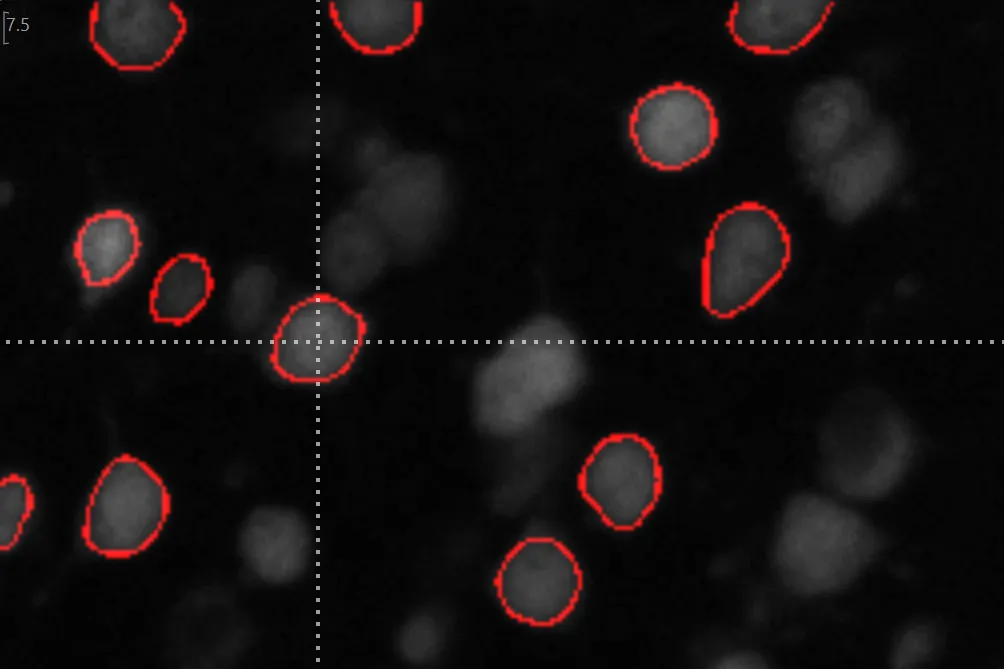
Segmented somas at 9× resolution, outlined in red (Fig. 4a of the paper). Abstract
Segmenting neuronal somas in 3D brain images through techniques such as tissue clearing and Light Sheet Fluorescence Microscopy promises to advance our understanding of healthy brains and the pathophysiological roots of neurological diseases, but it is costly and time-consuming. Automating the segmentation through deep neural networks shows promise but requires labeled ground-truth data that is labor-intensive and expensive to obtain. This work provides a platform within the open-source 3D medical image analysis software Vaa3D to quickly and precisely label and automatically segment neuronal somas. The binary segmented image is generated using a region-growing algorithm on somas that have been marked and bounded by a sphere around their center of mass, guided by a local Otsu threshold that can be manually overridden. The platform further supports principal component analysis of the segmented somas, allowing them to be rotated about their center of mass and aligned and for their characteristic shape to be captured in a probabilistic model. Finally, the platform supports the simulation of ground truth data, allowing segmented somas to be reoriented and repositioned according to probabilistic data, generating synthetic ground truth data that can be used to train deep neural networks. The platform’s source code is released along with this paper, allowing future work to build on its initial architecture: https://github.com/orgs/ImagiNeuron/repositories
- May 2026
AlphaGateau for Breakthrough: A piece of cake?
Key result
The CNN reaches a 100% greedy-evaluation win rate by iteration 40 while the GNN plateaus near 42%. 5×5 pretraining lifts early 8×8 performance from 17% to 67% at iteration 5. The CNN beats the best GNN 7–5 head-to-head (12-game evaluations).
What I did
Built the JAX Breakthrough environment, the self-play training pipeline and Slurm orchestration; trained the CNN; ran the head-to-head matches.
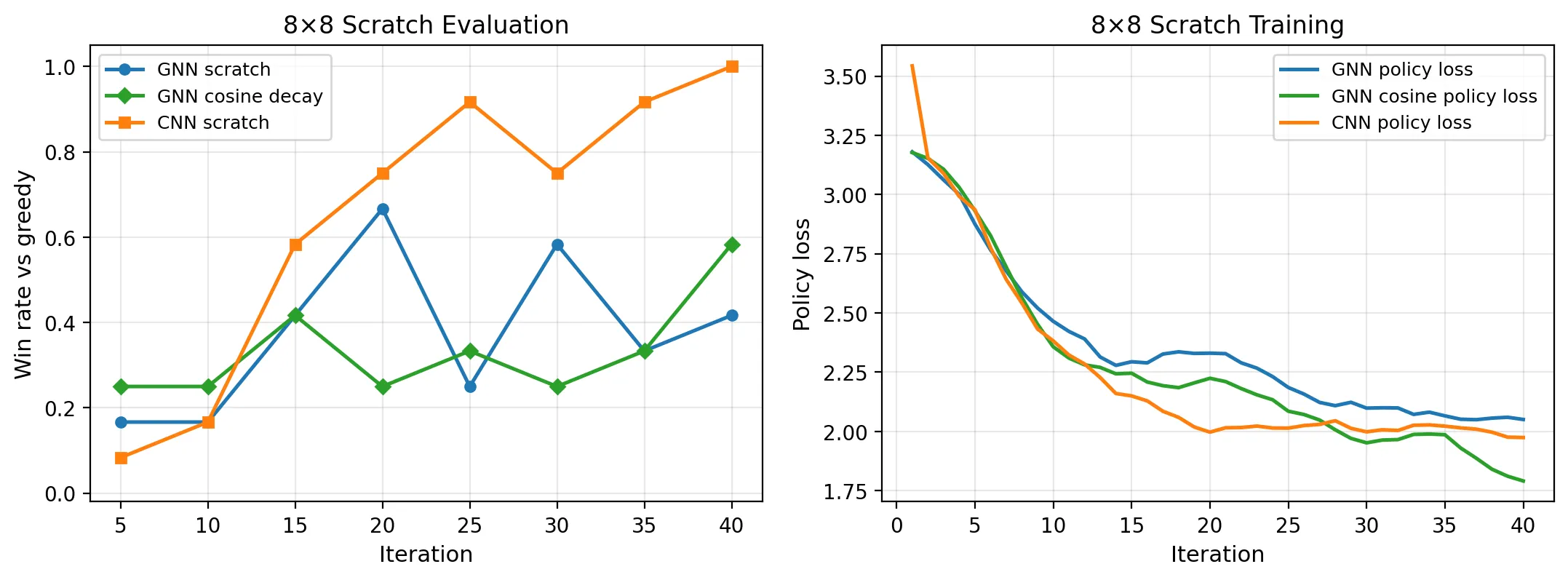
Training from scratch on 8×8: the CNN overtakes the GNN at iteration 15 and reaches a 1.00 greedy win rate by iteration 40 (Fig. 2 of the paper). Abstract
We study whether a board-size-invariant graph encoder improves self-play learning and cross-board transfer in Breakthrough. Using an AlphaZero-style training loop, we compare a graph neural network (GNN) with a convolutional neural network (CNN) on 8×8 play and in 5×5→8×8 transfer. Under our training budget, the CNN reaches a 100% greedy-evaluation win rate by iteration 40, while the GNN plateaus near 42%. Pretraining on 5×5 improves early 8×8 performance from 17% to 67% at iteration 5, but does not remove the CNN’s long-run advantage. In a direct 12-game match, the CNN defeats the best GNN 7 games to 5.
- Apr 2026
Energy Characterization of V-JEPA2 on the SOCS Teaching Cluster
Key result
GPU-centric but not GPU-saturating. Batch size 1 → 2 gives +42.4% throughput and −26.8% GPU energy per 1,000 samples.
What I did
Sole author: ran the course's 18-run measurement matrix, built the CUDA-synchronized phase profiler and 500 ms telemetry, and did the analysis.
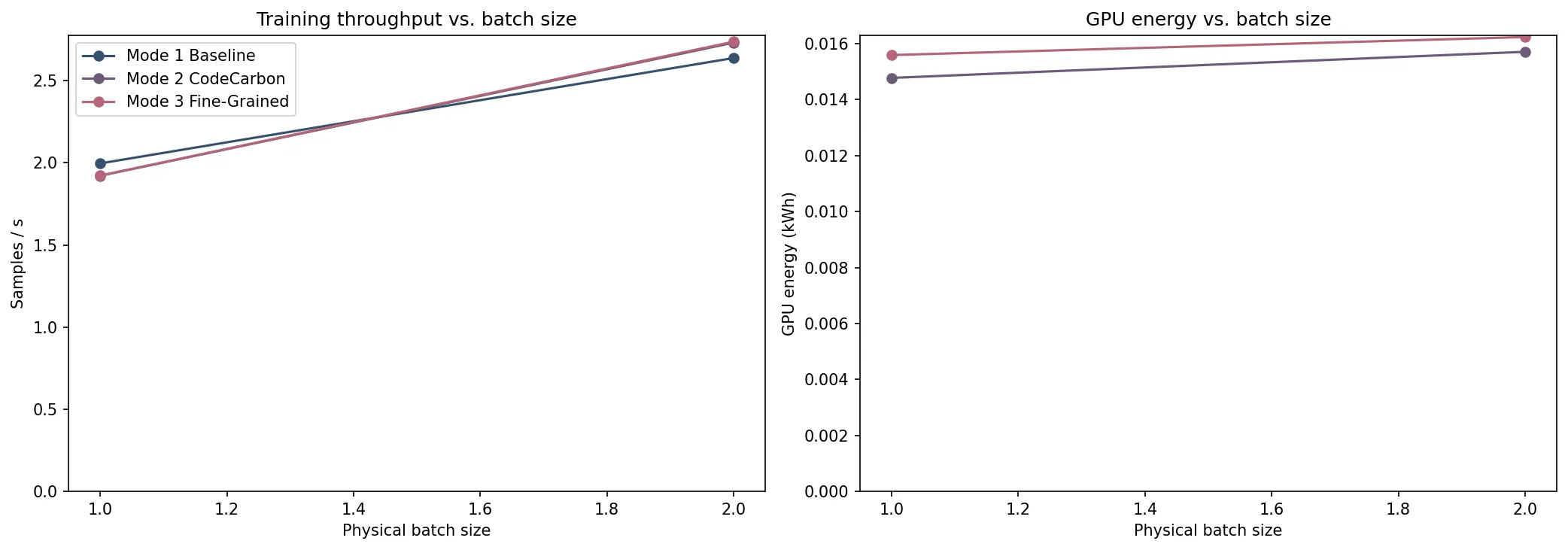
Batch size 1 → 2: each capped run uses slightly more GPU energy but processes 42% more samples, so energy per 1,000 samples falls 26.8% (Fig. 6a of the report). Abstract
This report studies the energy behavior of the V-JEPA2 training workload on the SOCS teaching cluster. The required experiment matrix contains 18 runs: three measurement modes, two physically feasible batch sizes, and three repetitions per configuration, each capped at five minutes. The measurements combine a true baseline, coarse end-to-end GPU energy via CodeCarbon, and fine-grained per-phase timing with 500 ms system timelines. The main result is that V-JEPA2 is strongly GPU-centric but not fully GPU-saturating: forward and backward phases dominate step time, the GPU repeatedly operates below 95% utilization while still drawing high power, and increasing the physical batch size from 1 to 2 improves processed-sample throughput by 42.4% while reducing GPU energy per 1000 processed samples by 26.8%.
- Apr 2026
PolarBench: Multi-View Graph Construction and Benchmarking for Stance Detection in Decentralized Social Networks
Key result
GCN on the Endorse view reaches Macro-F1 0.44, against a 0.177 majority-class baseline and a 0.54 inter-annotator ceiling.
What I did
Labeled and curated the gold-standard data and reviewed the final paper.
Abstract
Political discourse is migrating from centralized platforms to decentralized protocols whose heterogeneous interaction primitives expose structural gaps that existing stance-detection pipelines were not designed to address. We present PolarBench, a benchmark spanning three datasets (PolitiSky24, Fediverse-Gaza, Climate-COP28) that decomposes user interactions into three semantically typed graph views—Endorse, Conflict, Semantic—paired with a four-class taxonomy isolating Bipartisan Rejection under severe imbalance. On PolitiSky24, GCN on the Endorse view reaches Macro-F1=0.44, well above the majority-class baseline (0.177) and approaching the inter-annotator ceiling (0.54). A polarization audit shows DSP collapsing to a real-to-null ratio of 1.03 while RWC retains 7.69 on the same partition, revealing a PPR saturation regime under imbalance. A gold-standard LLM audit further shows ChatGPT 5.2 emitting zero Bipartisan Rejection predictions (F1=0.00) while Claude Sonnet 4.6 ET reaches BR F1=0.62, with inter-model unanimous agreement at 15.5% against a ∼20.1% random baseline.
- Dec 2025
Optimizing Global River Flood Forecasting via Meta-Modeling
Key result
Basin attributes were weak predictors of fine-tuning gain: the global model's own performance was the first feature selected on every split, and test R² was negative on 3 of 5 splits.
What I did
Equal contributor in a team of three, across every part of the project.
Summary
A global LSTM flood-forecasting model can be fine-tuned on local data, but fine-tuning is expensive and mostly helps a tail of poorly served basins. We trained a linear-regression meta-model that predicts the fine-tuning gain for a basin from its Caravan attributes (217 features from HydroATLAS and ERA5-Land) across the 159 basins that had been fine-tuned. To avoid spatial leakage we split train and test by region, and with more features than basins we used forward feature selection. The global model’s own performance was the first feature selected on every split. Test R² ranged from 0.76 (South America vs. the rest of the world) to −1.37 (UK vs. the rest of the world) and was negative on 3 of 5 splits. With this data, basin attributes are weak predictors of when fine-tuning pays off; a larger set of fine-tuned basins is the main requirement for a useful meta-model.
- Mar 2025
Quantifying Temporal Change in Sentiment Analysis: A Study on the Amazon Reviews'23 Dataset
What I did
Implemented data extraction, training and fine-tuning.
Abstract
This paper investigates the impact of the temporality of data on the performance and generalization of sentiment analysis models trained on review data from different time periods. Using a large dataset of movie and TV show reviews labeled as positive or negative, we partition the data into 3 distinct scales: individual months, individual years and multi-year groups. We fine-tune separate DistilBERT models for each time period using a binary sentiment classification task and evaluate their performance through cross-period testing, examining how temporal gaps between training and testing data affect model accuracy. Performance is measured using accuracy. Our experiment aims to pinpoint the specific duration of the gap that leads to noticeable performance degradation. Our results show how model performance degrades when applied to out-of-period data, highlighting the evolving nature of sentiment language and the importance of temporal alignment in training and testing data for robust sentiment analysis models. This study offers a more nuanced understanding of how linguistic and contextual changes impact model generalizability over time.


